


New Year’s Eve Resolutions for the Philadelphia Big 5

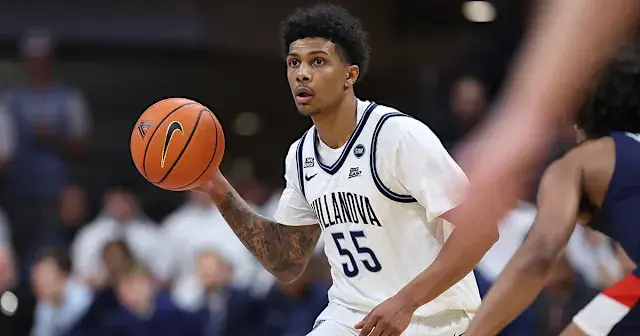
(Photo courtesy of Yahoo Sports)
New Year’s Eve in Philadelphia has always been about reflection, and as the college basketball season reaches its midpoint, the timing feels fitting. The first two months have stripped away preseason hype and exposed exactly who these teams are—and who they aren’t. For the Philadelphia Big 5, history still matters, but it no longer protects anyone. As conference play begins, each program faces a defining question: adapt, evolve, or get left behind. With the calendar turning, the second half of the season isn’t about potential anymore—it’s about accountability.
Saint Joseph’s — Stop the Free Fall
Saint Joseph’s basketball is in free fall, and the numbers back it up. After entering the season with legitimate A-10 aspirations, the Hawks find themselves hovering near the bottom of the league standings and struggling to string together complete performances.
The Billy Lange era ended unceremoniously when he resigned just months before the season to join the New York Knicks, leaving the program scrambling. Steve Donahue was elevated to head coach, inheriting a roster built for a different system and a different philosophy.
The Hawks flashed early promise, but since mid-November they have been one of the least consistent teams in the A-10, struggling offensively and failing to close games. The dismissal of reigning A-10 Rookie of the Year Deuce Jones II only magnified deeper cultural issues. Saint Joseph’s has too often lost games it should have been competitive in, and the effort level fluctuates nightly.
Statistically, this is a team underperforming relative to its talent. The Hawks are losing the rebounding battle in conference play and rank near the bottom of the league in defensive efficiency. This isn’t a personnel problem—it’s a program direction problem. Saint Joseph’s must decide whether this season is about survival or the beginning of a full rebuild, because the current trajectory points toward irrelevance.
La Salle — Stop Avoiding the Obvious
La Salle’s season can be summarized in one stat: five losses by fewer than 12 points. The Explorers are competitive almost every night, yet they sit at 4–9 because they consistently fail in the same area—three-point shooting.
La Salle ranks near the bottom of the Big 5 in both three-point attempts and makes, allowing defenses to pack the paint without consequence. When teams zone them, the offense grinds to a halt. In the loss to Penn, La Salle blew a 17-point second-half lead after the Quakers switched to a zone and dared the Explorers to shoot. They couldn’t—and didn’t.
This team doesn’t need a roster overhaul. It needs shooting development and offensive spacing. Even marginal improvement from beyond the arc could flip multiple close losses into wins. Until that happens, La Salle will remain competitive but harmless—one of the most frustrating places to be in college basketball.
Drexel — Decide Who You Are
Drexel may be the most confusing team in the city. On a per-half basis, the Dragons look like one of the best teams in the CAA. On a per-game basis, they look unreliable.
There have been multiple games this season where Drexel has outscored opponents by 15 or more points in a single half, only to give it back in the other. The inconsistency shows up statistically: wide swings in scoring margin by half and a defense that alternates between dominant and nonexistent.
Roster turnover—four players leaving for Power Four programs—explains some of the growing pains, but not all of them. Drexel has proven it can play elite-level basketball in stretches. Until it commits to doing it for 40 minutes, it will continue to waste its own ceiling. If it ever figures that out, a top-half CAA finish becomes the expectation.
Penn — This is the Foundation; Build upon it
Penn’s 6–6 record is misleading. Under Fran McCaffery, the Quakers are playing one of the toughest non-conference schedules in the Ivy League, facing Villanova, Providence, Rutgers, and Hofstra—and competing in all of them.
Despite losing star guard Ethan Roberts to during the Big 5 Classic Championship game and Penn has shown measurable growth on both ends of the floor. TJ Power leads the team in scoring since Roberts went down, while freshmen Dalton Scantlebury and Jay Jones are logging significant minutes without looking overwhelmed.
Statistically, Penn is trending upward in offensive efficiency and assist rate, clear indicators of McCaffery’s system taking hold. This team may not win the Ivy this season, but the data points are clear: Penn is building something real. By 2026, anything short of Ivy League contention would be a disappointment.
Temple — Remember Who You Used to Be
Temple can score with anyone. The problem is they defend like no one.
The backcourt of Derrian Ford, Aiden Tobiason, Jordan Mason, and Gavin Griffiths is among the most productive offensive groups in the AAC, but Temple ranks near the bottom of the conference—and nationally—in defensive efficiency. Opponents consistently shoot high percentages against them, and stops come far too infrequently.
This program was built on defense, physicality, and intimidation. John Chaney’s teams didn’t just win—they broke opponents mentally. Today’s Temple team plays with emotion on offense and indifference on defense. Being picked ninth in the AAC is a direct reflection of that identity crisis. If Temple recommits to defense, the offensive talent gives them a much higher ceiling than anyone is willing to admit.
Villanova — Don’t Waste This
Acaden Lewis isn’t just Villanova’s best freshman—he’s already one of its most important players.
Lewis ranks second on the team in scoring while leading the Wildcats in assists and steals, a rare combination for a first-year player. He is already producing at an All-Big East freshman level and impacting winning in multiple ways.
Villanova has the roster and efficiency metrics to compete for a Big East title, and Lewis is the engine driving that push. If his development continues on its current trajectory, he won’t just be a Freshman of the Year candidate—he’ll be one of the best guards in the conference by season’s end. Programs don’t get players like this often. Villanova cannot afford to waste it.
Big 5 Classic — Fix It or Lose It
The Big 5 still carries historical weight, but relevance is slipping. Attendance, intensity, and national interest have all dipped in recent years. Games that once defined seasons now blend into the schedule.
Rivalries require stakes, urgency, and emotion. Without meaningful incentives or structural changes, the Big 5 risks becoming a ceremonial event rather than a defining one. Phil Martelli has said it for years: tradition alone won’t save it. Action will.
The second half of the season will expose who in the Big 5 is serious about winning and who is content living off history. Talent alone won’t be enough, tradition won’t save anyone, and excuses will only grow louder as conference play grinds on. For some programs, this New Year’s resolution is about survival; for others, it’s about seizing momentum before the window closes. One way or another, the truth is coming—because in Philadelphia basketball, the calendar may reset, but the standard never does.
-Adam Mack


Comments